Guide to Cohesion
- Simulation Rules
- Establishing Influence
- Stakeholder Mapping
- Team Health Check Tool
- The Trust Cycle
- Roles, Goals, and Souls
- 10 Change Management Principles
- 10 Point Performance Assessment Checklist
Simulation Rules
Up to 4 conversations per week.
Up to 2 team interventions per week.
Back to top
Establishing Influence
Q1. Is this person influential?
- Do they have organisational authority?
- Do they have reputational/social influence?
Q2. What is their attitude to the project?
- Are they a supporter who can help the change?
- Are they an opponent who may hinder the change?
Q3. Can I influence this person?
- What relationship do I have with them?
- Are they open to being influenced on this topic?
Back to top
Stakeholder Mapping
Why use stakeholder mapping?
Stakeholder analysis or stakeholder mapping is a simple technique that should be used at the beginning of major programmes involving any significant change. Stakeholder mapping allows you to analyse the key "stakeholders" (i.e. actors) who might either be impacted by or have an interest in the programme. The purpose is to help you identify who you need to influence, in what way, and when (relative priority).
What does it show you?
The 3x3 matrix will show influence on one axis, and their attitude (supporter, neutral, or opponent) on the other axis.
Back to top
Team Health Check Tool
Teams have four distinct aspects: Meetings, Alignment, Communications, and Team Support.
Each aspect has four sub-sections.
Using the in-simulation information, you will decide on the process health and process priority score for each sub-section. This will give a process health score, that will tell of the overall health of a high performing team.
The tool will allow teams to prioritise the foundational, intermediate, and advanced team aspects to build a process to fix their team from the bottom (foundational), up!
This tool can be used externally though the Business Simulations website to help with prioritising and building processes for your own high performing teams.
Back to top
The Trust Cycle
Back to top
Roles, Goals, and Souls
Roles
Roles can be structured into team and functional roles.
Team - Leader, note-taker, timekeeper, etc.
Functional - Divisions, departments, directors, etc.
Goals
Goals can be structured as either team or challenge goals.
Team - Learning & behaviours.
Challenge - Setting targets, strategy and execution.
Souls (Values)
Souls can be structured into team and organisational values.
Team - Ground rules and etiquette.
Organisational - Core values (customers, staff, shareholders, shared community...)
Back to top
10 Change Management Principles
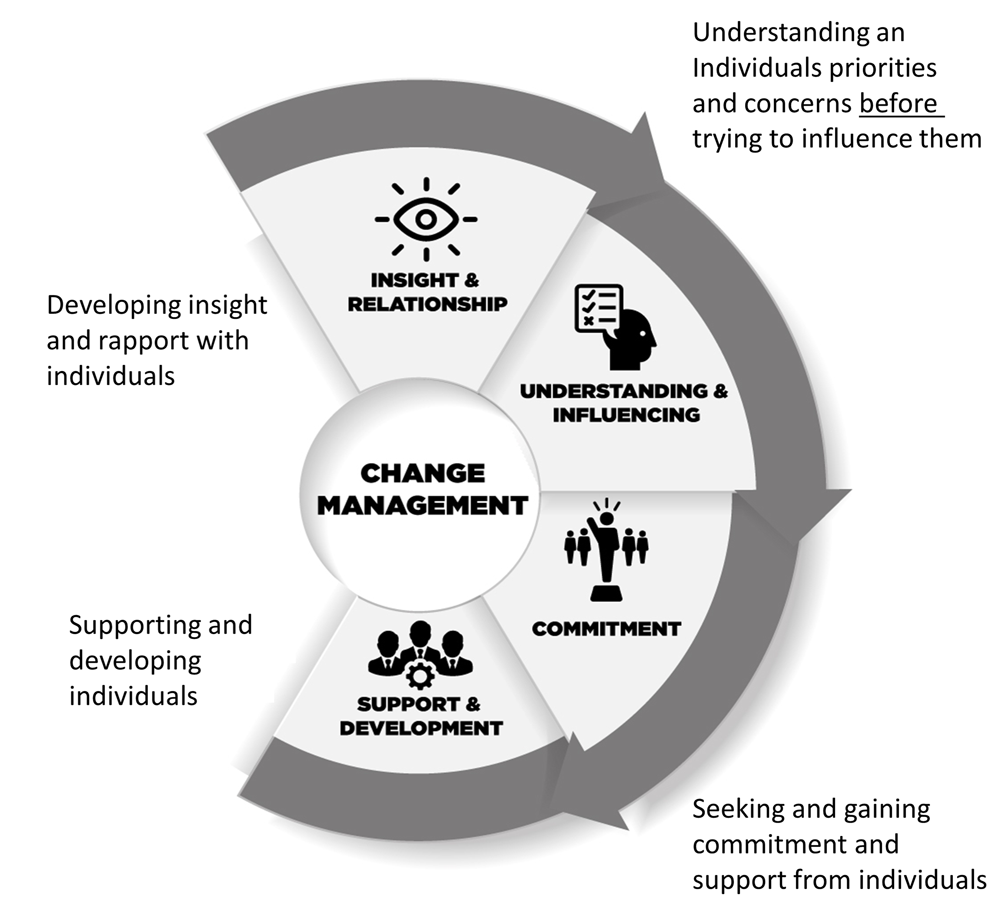
- Build as much insight and relationship as you can with an individual before you intervene.
- Make appropriate interventions which are relevant to the individual’s attitude (e.g. don’t ask an opponent to become a champion) and use light touch interventions (e.g. opinion/advice seeking) with those who are negative.
- Build on influential supporters rather than neutralising opponents, however ...
- Don't neglect high-profile opponents - they could derail the change if ignored.
- Intervene with those who have influence over others (through their authority or social reputation) and make them champions.
- Intervene with those you can influence (which depends on their relationship with you and their openness to the proposed change).
- Don’t neglect indirect interventions (e.g. teams and colleagues) as well as direct (one-on-one) interventions.
- Never stop nurturing supporters otherwise enthusiasm and commitment can wane.
- Be patient - adoption is often slow to start - if you are confident you are doing the right things then stick with it even if initial results are not yet apparent.
- Be creative - sometimes you just need to do something not in the standard playbook!
Back to top
10 Point Performance Assessment Checklist
Preparation
- Developing, following and adjusting a well-researched change plan.
- Developing and communicating a compelling change narrative.
Building an Effective Platform for Change
- Building around influential supporters.
- Engaging influential opponents early.
- Getting early wins (change champions).
- Broadening change platform when required (and not neglecting people).
Making Good, Timely Change Interventions
- Evidence of an intervention strategy.
- Building rapport where necessary first before making other interventions.
- The right Intervention at the right time.
- Making good use of indirect and custom interventions.
Back to top